Safe, sustainable construction
We are committed to ensuring our buildings are constructed responsibly and their ongoing operation has a minimal impact on local communities and the environment. This is how we can make a meaningful contribution towards achieving SDG 12 (Responsible Consumption and Production) and SDG 13 (Climate Action).
- All our construction teams in the UK and across Europe follow sustainable construction principles and, wherever practicable, use materials that have recycled content or are derived from sustainable sources.
- Where feasible, concrete from existing buildings on site is demolished, then crushed on site and re-used in the new development.
- We monitor the waste and energy usage on every site and introduce efficiencies identified into future building projects.
- We design our stores to provide a safe, secure home for our customers’ possessions and we build them with consideration given to our colleagues, our customers, our communities, our investors, and the environment.
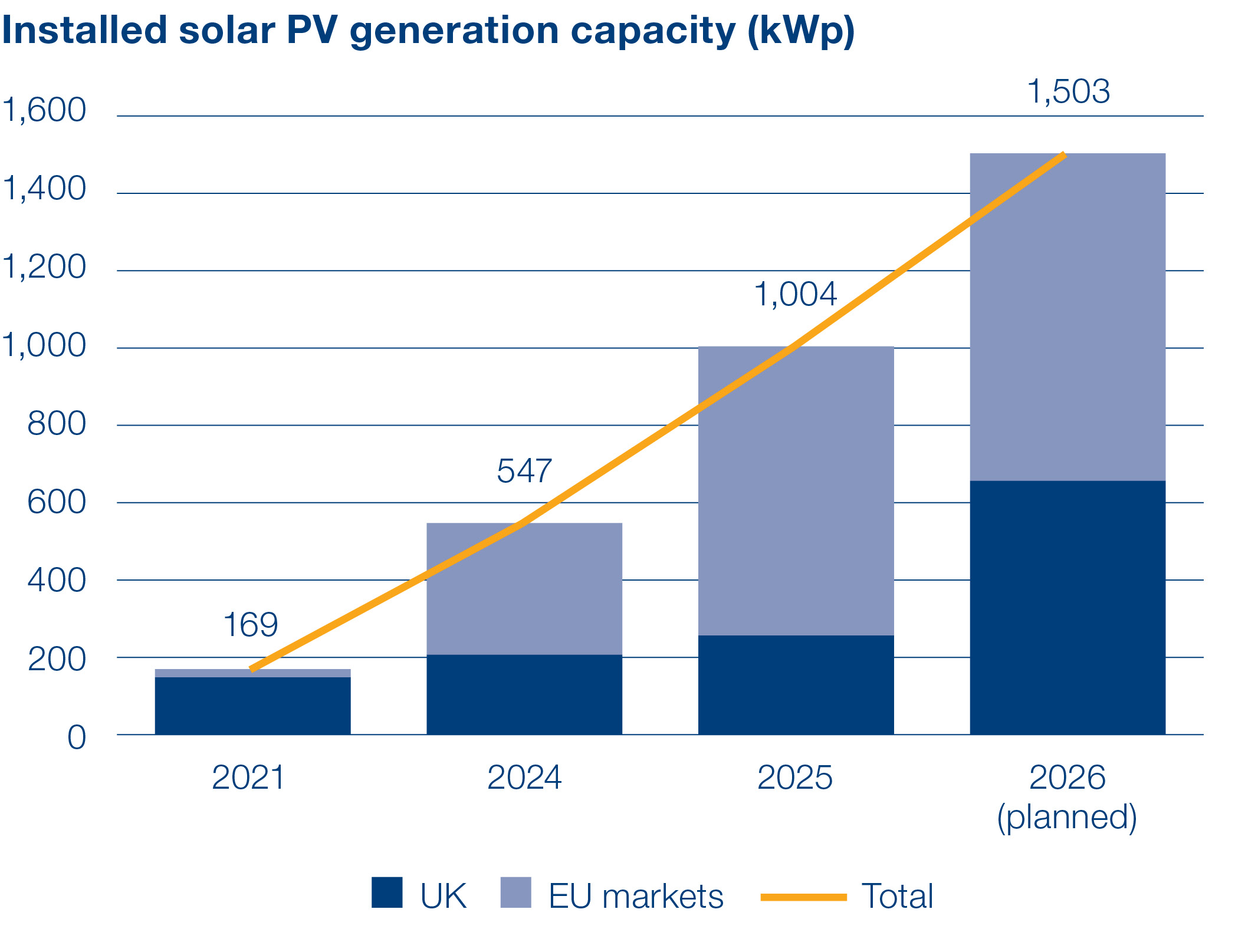
- Since the beginning of 2024, where structurally/practically feasible, we have been installing solar PV systems and electric vehicle charging points in new stores. During the year, we installed solar PV systems at our stores in Lea Bridge, Buchelay, Amsterdam New West, Melsbroek, Madrid (Carabanchel), Madrid (Barajas), Pamplona, and Barcelona (Manso).
- All new store developments provide bicycle parking for both our customers and colleagues.
New store development – construction waste and recycling
In the UK, our Lea Bridge store achieved 97.9% landfill diversion for its construction waste. Across our European operations, we have set a goal of achieving 98% landfill diversion within the next twelve months as part of our commitment to responsible waste management.
In the UK, we continue to partner with the Community Wood Recycling charity (“CWR”) to ensure that wood waste from our construction sites is re-used. We require our principal contractors to set aside all waste wood for collection by CWR, which repurposes it into a range of garden products, from flowerbeds to benches and tables. By collaborating with CWR, we are not only reducing landfill waste but also supporting community-based re-use initiatives that develop skills for the many volunteers who work with it.
As a Group, we are dedicated to recycling or recovering 100% of soft and hard plastics from our construction projects. We continue to work closely with our suppliers to reduce the amount of plastic packaging arriving at our sites and to further decrease plastic usage over the coming years. We are committed to phasing out all non-essential plastic products by 2030 as part of our ongoing sustainability journey.
UK Considerate Constructors Scheme ("CCS")
In the UK, construction sites, companies, and suppliers voluntarily register with the CCS and agree to abide by the Code of Considerate Practice, which is designed to encourage best practice beyond statutory requirements.
Our new store in Lea Bridge scored an average of 44 out of 45 over the course of its two visits, putting it in the top bracket of scoring. The inspector highlighted all areas of the inspections as ‘Excellent’, which highlights the exceptional effort and commitment that our construction team makes in raising the standards of our new store developments.
Energy Performance Certificates (“EPC”) of new buildings and conversions
EPCs in the UK and their equivalent in European countries set out the energy efficiency of a property using a traffic light system of A–G, with ‘A’ being the most efficient. Since 2024, our target has been to ensure that 100% of new store developments in the UK and across Europe (excluding France, where certification of self-storage buildings is not conducted) would achieve a minimum EPC rating of ‘B’.
We are pleased to report that in 2025, all of our new buildings achieved a rating of either ‘A’ or ‘B’∆.
Building Research Establishment Environmental Assessment Methodology (“BREEAM”) in the UK, the Netherlands, and Spain, and Haute Qualité Environnementale (“HQE”) in France
BREEAM/HQE certification is a local planning requirement for some of our new stores in the UK and across Europe. The methodology assesses the impact and opportunity for enhancing the environmental aspects of design and construction.
The certification includes a review of new store energy, sustainable building materials, water efficiency, waste recycling, and ecology. The review also includes social aspects of the building life, including resource management, health, wellbeing, modes of transport, and pollution reduction.
Regardless of whether a site is BREEAM certified, we strive to build to a minimum standard of BREEAM ‘Very Good’ on all our new store developments across the UK and the Netherlands.
Our Lea Bridge store, developed during 2025, achieved a BREEAM ‘Very Good’ rating.
Safestore construction standards
We have a long-standing commitment to providing both a long term sustainable investment and a pleasant and safe environment for our customers and colleagues.
Our stores are built or converted to achieve similarly high standards; however, the configuration of an individual store may vary.
Safestore commitments from 2024/25 onwards are:
Best practice – internal/
external expectation |
Safestore commitment |
Applicability |
| BREEAM/HQE |
Equivalent to “Very Good” |
Across all new build stores |
| BREEAM/HQE |
Very Good |
Where part of local planning |
| Sustainable drainage systems |
Included |
Across all new build stores |
| Solar photovoltaic |
Roof-mounted photovoltaic |
PV cell systems on all new own build developments |
| Considerate Constructors Scheme |
Score 40 or higher |
All new stores |
| Ecology |
Protect existing and improve biodiversity |
Across all new build stores |
| Energy |
Efficient LED lighting with built-in motion sensors |
Across all existing and new stores |
| Security |
Operate safe and secure facility |
Across all existing and new stores |
| Energy Performance Certificate (or equivalent) |
Rated B or higher |
All new stores |
Construction material: recycled content
Typically, the construction of one of our stores may include the following:
| Building material |
% of build cost |
% recycled content |
| Steel (main frame) |
4 – 5% |
Minimum 56% |
| Concrete |
3 – 4% |
29% – 37% |
| Cladding (walls and roof) |
7 – 9% |
50% but Kingspan target improvement using recycled bottles by 2030 |
| Particle board (FSC certified)(mezzanine floors) |
2% |
85% |
| Brick and block walls |
3 – 5% |
9% – 55% |
| Glazing |
2% |
Glass 25%, aluminium frames 60% |
| Hardcore (piling mat) |
1% |
100% |
Construction health and safety
Safestore has a robust health and safety policy where we aim to exceed minimum standards. Accordingly, our development projects experience very low incident levels compared with our peers. During 2025, the number of reportable incidents on our construction sites was zero.
Consultation process
As part of any local planning process, we consult widely amongst the community and those most likely to be affected by any development.
Notes:
∆SLR Consulting Ltd (“SLR”) have provided independent limited assurance in accordance with the International Standard for Assurance Engagements 3000 (ISAE 3000) and Assurance Engagements on Greenhouse Gas Statements (ISAE 3410) issued by the International Auditing and Assurance Standards Board (“IAASB”) over the selected metrics identified with a Δ. SLR’s limited assurance statement, which includes details of the selected metrics assured, can be found in the Sustainability section of the Group website.